Thursday, June 16, 2011

Day Eleven: June 16th, 2011

          Today we went to the Kuranda rainforest for a day of exploration. We took a scenic train up to the town, which was on top of a mountain. It was a gorgeous view the entire ride. Afterwards, we took a sky gondola back down, and we stopped halfway for a quick rainforest walk. Then, we continued our way back down the mountain, and ended up stopping to see an Aborigine show, watch didgeridoos get played, have a weapons demonstration, and learn how to throw spears and boomerangs.

Prompt: TOP TEN.
1. Sydney Harbor Bridge: The bridge was probably my favorite experience because it was something I never expected to be able to do. I completely got over my fear of heights while I was up there and just took time to take it all in. At the summit of the bridge was when it hit me that this was all real, not just some dream. I was in Sydney, and I felt on top of the world. It was the most self-fulfilling experience that I have ever had.
2. Rangitoto College: The hospitality of the Kiwis puts them at number two. I absolutely adored the students and all of the people there. They were so sweet and knew how to make us feel welcome. I loved watching the Maori students dance the haka and it was such a true cultural experience to see and try that. I loved that school.
3. Great Barrier Reef: The GBR was incredible. I loved seeing the gorgeous fish and coral. The colors were amazing as well as were the many arrangements of underwater communities. The entire experience was beautiful and I wish I could have stayed and explored for days.
4. Ogo: Although there is zorbing some places in the states, the ogo here was awesome. I had the time of my life in the machine, just flopping around in the water with friends. Loving the whole hamster-in-a-ball feeling.
5. Whaka Village: The Whaka village, despite its snell, was gorgeous. I loved seeing the hot springs, colorful sulfur deposits, and the public baths. It was such a different way of life and I loved that they cook food in wooden boxes over hot springs and call them microwaves.
6. Cairns: I love the weather of Cairns, the freedom, and the water. I love exploring for hours each night, finding some delicious dinner, getting gelato, and going in the hot tub. Here, it just feels like I'm on a relaxing vacation with friends.
7. Sydney: I love Sydney. The boardwalk overlooking the harbor. Shopping at the Rocks markets. Hearing amazing street musicians and just stopping dead in my tracks. Sydney was gorgeous from all angles, whether it be from a boat in the harbor, on top of the bridge, or in the Sydney Tower.
8. Luge: I love the Rotorua luge. On top of a beautiful mountain overlooking Lake Rotorua, trying something that I had never done before. Go-karting fown a scenic mountain? Yeah, I'd do that again.
9: Burger Fuel: This restaurant is on my list because it was hands down the biggest and best burger I have ever had.
10. Sticky: Sticky makes hard candy, in front of the public. Located in the Rocks, I love how friendly and generous they were, giving out free samples and even lollipops. That place was so stinking cute.

Wednesday, June 15, 2011

Day Ten: June 15th, 2011

Prompt: Write about your Great Barrier Reef experience (summary included in prompt).
          In one word, the Great Barrier Reef was incredible. That was exactly what I kept describing it as. The hour and a half boat ride was perfect for anticipation to build up, and the sunny eighty degree day was a nice touch as well. We were able to soak up some rays without it feeling like an "are we there yet?" ride. Once we arrived at the reef and docked on the pontoon, it was so easy and quick to grab snorkel equipment and just jump on in the water. It was just the right amount of cold mixed into the warm sea, and I was ready to go. The last and only other time that I have ever snorkeled was in Disney World, and I was utterly terrified. Today, nothing could stop me; all I wanted to do was explore. I was running on pure adrenaline and just wanted to see as much of the GBR as I could. I saw coral in blues, oranges, yellows, and neutrals, and they were all mesmerizing. The shapes they formed were so abstract, ranging from what looked like branches to what looked like pasta or Tostito's scoops chips.
The fish, which typically tend to freak me out, were gorgeous. My favorites were what I called the rainbow fish. Never did I see two that looked exactly alike. Every fish had different colors, mostly consisting of greens, blues, purples, pinks, and sometimes even oranges. They were seriously beautiful. But I saw tons of other fish as well, and Mr. Schagrin and Mr. Ewen even got video footage of a small shark swimming through the reef (they were absolutely elated, by the way). I got to touch a sea cucumber and even held a small starfish that only spanned across about three fingers wide at most.
The sea cucumber felt like a slimy blob, which is exactly what it looked like, too. I got the chance to ride in a glass-bottom boat, which was really cool. It probably would have been even better had it not been low tide, with coral peeking out of the water, which prevented us from driving over it, obviously. But it was still awesome anyways. Underneath the boat, I could see entire communities of fish and coral cooperating together. It reminded me a lot of "Finding Nemo," when the schools of fish stop for one another at underwater intersections. The fish relied on the coral just as much as the coral needed the fish, for things like shelter, food, and protection. While on the boat, I also caught a glimpse of a sea turtle; that was awesome. I immediately wished that I would have been able to snorkel with one, because one of the GBR guides said that if you were friendly to the turtles, they would most likely follow you for the rest of the day. Still, I had an absolutely terrific time in one of the seven natural wonders of the world. It was an utterly gorgeous day in one of the most beautiful places I have ever seen, and an experience that I will never forget.

Tuesday, June 14, 2011

Day Nine: June 14th, 2011

          Today we flew to Cairns and had a lazy day at the beach! Well, technically we spent the day at a pool, which Alec kept calling a "man-made lagoon". We had a good time swimming in the freezing cold water, laying out in the sun, and getting some ice cream. Later on, we got three hours of free time to explore Cairns and find a nice place for dinner. We spent some time playing at a park, then went out to eat, where Arnaud decided to take "the challenge" and ended up consuming two kilograms of food. That's four and a half pounds. Yikes.

Monday, June 13, 2011

Day Eight: June 13th, 2011

         The weather turned out too be too poor and the water too choppy for my group to go on our whale watching excursion this morning, so instead we visited Paddy's, an indoor market. It was fairly large and covered in vendors, from produce to fake designer handbags (this turned out to be pretty handy considering the zipper had just broken off of my duffel bag a few days prior, and we were about to fly again the next day!). I had a good time perusing around with my friends, but I would have liked to whale watch all the same. After Paddy's, we walked around and explored the Rocks again, where we got free samples from a candy store called Sticky. They make hard candy right in front of you, it was so cool! Next, we headed over to the Sydney Harbor Bridge for the bridge climb, something I had been anxious about since signing up, because I was afraid of heights. Did you catch that? WAS. Not anymore! The bridge climb was incredible. Like I said before, I hate wasting time being scared when I could be treasuring these experiences because I doubt that they will ever happen again.

Prompt: Am I a good traveler?
           If there were no teachers here, I actually do think I'd somewhat be able to get by. I am constantly worrying about people on this trip, so I have become a lot more alert. At the same time, I have often stopped to just have fun and soak this all in. My friends and I have a system, all helping each other out with laundry, food, and other packed items that we will share with one another. The group system works very well for us because we are having a great time exploring the cities together. Personally, I feel that even though I am a teenager, I am responsible enough to travel and get where I need to be. I don't know if I could do it entirely alone, but if I were to travel with a group of about seven or eight, I truly do think we could thrive. We might possibly get lost going from place to place, but I think that is all part of the adventure. We are all cognizant teens and this trip has really helped to get us to that point. As an individual, I believe that I could travel on my own, but I might not enjoy it, simply because I have so much fun with other people and we all help each other out. However, once I am older, I think that an alone trip, or one with just one other person, would be beneficial in the sense that I would have to stop relying on others and take time just for me to have my own adventure; who knows where it will lead me?

Sunday, June 12, 2011

Day Seven: June 12th, 2011

          Today, Alec took us on a tour to see even more of Sydney. First, we took the coach to a beautiful, rocky area along the coast for a picture-perfect view of the Sydney Harbor. Of course, we had a photo opp here, and then we moved on to see Mrs. McQuarie's chair, where she would wait and watch for ships carrying the latest fashions from other countries.
Alec then took us around town and over to the place where whale watching typically takes place. I would call it a beach, but it was actually a cliff. We got time to explore and play on the rocks as well as to take in the view of the perfectly blue water beneath us. A few of us even spotted what looked to be a seal, although we still aren't quite sure whether or not it was living or dead. From there, we moved on to Bondi beach, which was gorgeous; too bad it was fifty degrees and rainy! After stopping for a snack at Bondi, we visited the Opera House, but unfortunately did not have tickets to go inside. We got time to explore the harbor area before meeting up for a harbor cruise. We got to see the place from every angle, and it was a lot of fun and a beautiful view! The cruise dropped us off right by Sydney Wildlife World, and the group went inside for a chance to see all that Australia has to offer. We saw kangaroos, koalas, wallabys, and more! It was an awesome opportunity.

Prompt: Feelings about travel this far (Have I grown? How do I know this?).
          I think that simply staying together has been my biggest difficulty while traveling. It's not that I go off on my own, it's just the fact that I have made friends with the majority of the class, so I may start off walking with some people, talk to others, and get distracted. However, my group typically waits up or starts talking to the other group, too, so it has all worked out fine. I think my biggest problem is just that I've never traveled with this big of a group of friends before, so I feel the need to keep track of them because that's just how I am. I always want to make sure everyone is where they need to be and is feeling okay.
          I have surprised myself with my ability to keep up with the time zone differences and I really do think that I am simply tired from having these long days of go, go, go. I have branched out and gone out of my comfort zone. Every day I try new things and grow closer to another person on this trip. I love the feeling that I am being able to accomplish so many things at once. My days have gone to good use! I've grown in the sense that I feel so much more cultured in every sense of the word. Not only have I learned so much about the culture down under, I feel as though I have experienced it. I have also had to take on more responsibilities, as I have seen that I really am being treated as an adult on this trip. I feel as though I have so much more respect for so many different types of people, both foreign and in our group, after learning so much more about their personal journeys.

Saturday, June 11, 2011

Day Six: June 11th, 2011

Prompt: Reflection of Day One in Sydney and compare to other cities, such as Chicago (summary of the day included in reflection).
         Today was one of the longest days of this trip without feeling like it. We got a chance to explore Sydney, catching glimpses of the Opera House and Harbor Bridge. Going up to the top of the Sydney tower was beautiful, and I realized just how absolutely huge the city is. I was surprised that I could look out the window at the city around and underneath me, and in that moment not be afraid of heights. I think I just get that way when I know I'm in a place I probably won't ever return to; I don't have time to be scared because that would be taking where I am for granted.
          We got a chance to visit the Rocks on a Saturday, meaning that the weekend street market was going on. There were tons of vendors, ranging from jewelry to clothing to wood carvings and corn on the cob. Even though it was raining, it was an experience that was definitely worth while, and it was a plus that part of the market was covered by a large tent. After the Rocks, some people opted to take the subway back to the hotel, while I chose to walk in the rain with a few others. Nobody had anything more than a cardigan or sweatshirt, and we soon made friends with acquaintances who gave up their hoodies for us girls. It was nice to see how we all worry about one another, constantly yelling that the other was going to get sick. The walk may have ended up taking an hour rather than the expected fifteen minutes, but it definitely helped us to bond. Some people sang in the rain while the rest of us just talked to people whom we had rarely ever held full conversations with in the past. Traveling hafway across the world will do that to a person.
          The walk also helped me to see more of Sydney than I previously had. And I am thankful for this, because a little part of me fell in love with Sydney; if I was going to live in a city someday, it would be here. Nonetheless, Sydney is still a city. I was able to see that it is just like Chicago in a sense: big and beautiful, but with its dirty parts. I do love that Sydney is right on the water though, and I don't mean a lake. I love the harbor and that Sydney is right on the coast of Australia. Every view is fantastic and I'm sure that there are great beachfront festivals throughout the year. The harbor gives Sydney a sense of proximity as if everything is centered around it. However, closer inspection reveals that the city is so much larger than most people typically imagine and is so much more than meets the eye, complete with beautiful parks and bustling streets.

Friday, June 10, 2011

Day Five: June 10th, 2011

          We started the day early, catching the public bus to take us to the Redwood forest for a hike. Unfortunately, the weather did not agree with us, and the rain just kept coming down. However, it was a cool experience to take public transportation in a foreign country, and to talk to the local school kids who were just trying to get to class on time. The forest was gorgeous, and when we were finished hiking we went looking for the other group, and ended up standing in the rain for close to a half hour until we spied them walking down the road, singing as always. A little rain never hurt anyone!
Once the bus reached the stop, we set off on our way back to the hotel to put on some dry clothes and head back to Auckland for the night. After another three hour drive, we made it to Rangitoto College in Auckland for a party with the students there. Although it is called a college, Rangi is really a high school. I met so many incredible people, including my pen pal, Rebecca. I loved chatting with them, comparing and contrasting our everyday lives. It was a great night, filled with singing, dancing, and tons of food! Meeting kids from another country and realizing how much we have in common was definitely an eye opener for me, showing that it doesn't matter where you live, teens will be teens!

Prompt: Reflection of morning and night, include any thoughts running through your head.
          Hiking through the Redwoods today, I had very mixed emotions. On the one hand, the autumn-like colors of the trees as well as their great height and numbers were absolutely breathtaking. On the other, it was rainy and we had to wait a long time for the public bus as well as the other group to catch up with us. I can't complain though, because the beauty of New Zealand makes up for just about anything and everything in my book.
          Meeting the Rangitoto students tonight was also fantastic and more than outweighed the wet hike of this morning. Everybody at Rangitoto College in Auckland was so sweet. Seriously. They were all so welcoming and hospitable. I loved the carefully planned decorations, the food which the students helped grill themselves, and the music, some of which was American and some which was not. Mostly I loved the people. The Maori kids did a welcome, in which you touch noses with the other person, and they also did a song and dance just for us. They also taught us how to dance the haka, and it was hysterical doing it against each other, half the room versus the other half. Rebecca, my pen pal, proved to be a lot like myself, and it was really hard to say goodbye, even though we had only known each other for three hours. I really do hope we stay in touch, and she vowed to email me as soon as she got home. I checked my inbox; she kept her promise. Talking to everyone was just so easy and it was so much fun to see what we all had in common. I also loved when they tried to immitate our accents. All in all, I had a fantastic night. I loved those Kiwi kids! It was incredible to see how much they cared and how excited they were to have us visit; we were treated like celebrities, us small town average Joes. The New Zealanders are some of the nicest people I have ever met, whether they were in Rotorua or Auckland. I will definitely never forget this experience, and I will have to return here some day (or at least I'd hope to). Today was fantastic. One of my favorite nights by far.

Thursday, June 9, 2011

Day Four: June 9th, 2011

         Today was a day for getting to know the New Zealand culture, especially that of the Maori people. First we went on a duck tour of Rotorua, but the steam from the springs covered the water and we unfortunately didn't get the chance to see much. Next, we visited Whakarewarewa, a geothermal village that houses only about twenty families. We saw how the Maori people living there fully utilize the land, using it for cooking as well as bathing. They have communal baths, which we got to put our hands in. The minerals in the water made my hand feel so dense, but when it dried I felt as though I had lost all of my dead skin. Bathing in that would be just like going to a spa. After the Whaka village tour, we visited Mountain Jade, a New Zealand jade factory. It was fun to learn about how they shape and carve jade for jewelry, and how the carvers are inspired by Maori symbols, such as a swirl symbolizing new beginnings.

We then moved on to the Agrodome, where we got to play with baby goats and lambs, and then we saw a sheep show. Different breeds of sheep were showcased, one was sheered, and a cow was milked. It was a nice taste of typical Kiwi life. After that, we went to do the Ogo, which is like a Zorb or a giant hamster ball. While I didn't do it down hill, Zoe, Morgan, and I went in the stationary machine one, and I had the time of my life! It was filled with warm water, and it was so fun to get tossed around and soaked, falling all over each other. I absolutely loved it. We finished off the day by going to a hangi feast at our hotel, in which we tried traditional Maori dinner and desserts. I really liked getting to taste Maori food, even if it wasn't exactly up my alley. I also had a great time trying the poi, which is explained below, and watching the boys dance the haka. My only complaint was that the performers were not very authentic and took away from my experience.

Prompt: Describe the culture of this morning and afternoon, then compare to the USA and Native Americans.

                This morning’s tour of the Whaka village was not at all what I expected. We were given the background history of the Maori people and Whaka guides. I did not expect the actual village to just have these beautifully colored sulfur and mineral deposits and “clear as” pools sitting in between everyday homes. I thought it was incredible how they tied bags to a string and left food (like corn) to cook in the hot, boiling pools. The “microwaves”, or boxes made of wood that were heated by the ground they were placed on, were another resourceful idea that shocked me.
We don’t have anything like that in Grayslake; the closest thing is probably an actual microwave. Seeing a demonstration of the poi, balls attached to string that are used for song and dance, by our guide gave me some insight of what the hangi dinner would be like later that night. Although the performance at dinner seemed much more artificial than that of our guide, mostly due to gossiping performers and the use of black lights, I did take away a taste of Maori culture from it all. The food was cooked in the thermal area and tasted great, yet interesting because it really was so different. Learning a poi dance was great fun and also a very unique experience; I am very glad that I tried it because I got to attempt something that the Maori women have mastered and perform at their ceremonies. The boys really seemed to enjoy learning to dance the haka, and the entire day’s experience taught me so much about the Maori culture. I saw how rich in tradition they are and how they continue to live fairly simply. They utilize their surroundings and resources to the fullest, just like the Native Americans did with buffalo, using every part they could to its full potential. The Maori keep their ceremonies alive as a way to keep their culture alive as well. This reminds me very much of the Native Americans because both people are this way. However, the Maori culture is so much better preserved in New Zealand than the Native Americans because they are not confined to preservations if they want to practice their culture. I believe that the Native Americans should be allowed to spread their traditions freely, and not have to live on preservations if they want to live around other people like them who share their beliefs and culture. Sure, many do participate freely in society, but they could easily flourish if their culture’s spread was being aided, and their preservations were being well taken care of.

Wednesday, June 8, 2011

Day Three: June 8th, 2011

          After a long plane ride, we met our tour guide, Alec, and bus driver, the awesome Lionel. We got straight into the coach and headed for Rotorua, about three hours outside of Auckland. Driving through the New Zealand countryside, I was wonderstruck by its beauty. The scenery out my window was too pretty to be caught on camera; it was amazing there. We stopped about halfway in Matamata, AKA Hobbiton. You guessed it, it's where the Lord of the Rings was filmed. After a lunch break and about another hour in the bus, we arrived in Rotoura. The town smelled of rotton eggs thanks to all of the sulfur in the geothermal area. Nonetheless, it was beautiful, with a layer of steam covering the mountains. Again, it was picture-perfect. We took a sky gondola up to a mountain overlooking Lake Rotorua, and had a blast trying out the scenic luge, which is like a go-kart down a cement path. It literally went halfway down the mountain, and I had the time of my life exploring with my friends.

Prompt: List your initial impressions of New Zealand, as well as three culture shocks and what else you are looking forward to.
                My initial impressions of the last 48 hours were absolutely scattered. Upon entering the school before departing, I could tell that this would be a great group of kids to travel with, seeing that we all fed off of each others’ excitement. Once we arrived at the airport and the computers started crashing, I felt like the trip could easily fall apart at any moment; I didn’t even have an actual seat on the plane! Once we got travel arrangements figured out and arrived in New Zealand, however, I felt as though I had arrived in an entirely new world. Driving on the left side of the street, gas prices at $205.9 per liter, and scenery that was straight out of Narnia cemented my thoughts. The beauty of the New Zealand countryside cannot be captured by a camera; everything here is just so spectacularly, magically different.
                The fact that the passenger’s side and driver’s side of cars are flip-flopped in New Zealand definitely shocked me. I caught a glimpse of a three year old sitting in what I instinctively thought to be the driver’s seat and I almost freaked out. My second shock would have to be the countryside. Like I said before, it is indescribable. No pictures do it justice, and the everglades found in between Auckland and Rotorua look almost artificial, as if they came straight out of a movie. I had no idea what to expect when we arrived in NZ, and the scenery definitely blew me away. My third shock is simply the kind nature of New Zealanders. Kiwis stopped us both on the streets and in stores to ask where we were from, what our trip entailed, how we got chosen to come; the list goes on. Bottom line is, if you walked into a café back home with no intention of buying anything, I doubt anyone would offer you water, a restroom, and a place to relax.
                For me, this trip is all about pushing my limits, so I can’t wait to do just that. Today I tried the luge, and later on I will attempt to conquer my fear of heights by climbing the Sydney Bridge. I will snorkel in the Great Barrier Reef, and I will make friends with both people from Grayslake as well as Down Under. So far, so good!

Tuesday, June 7, 2011

Days One and Two: June 6-7th, 2011

Anxious to set out on our adventure, all thirty six students, five teachers, and our families met at North on Monday to get a head count, say our goodbyes, and board the bus to O'Hare! The computers crashed at the airport when they started to hand out our boarding passes, and there was an air of tension throughout the group. Some people even said this was the first sign of the trip to come; not good. Once we all got our passes, we rushed through security and hurried to our gate. By the time we boarded our flight to LAX, tensions were beginning to ease. We ran into some more trouble in Los Angeles, however, with a few students who were having ticket troubles (myself included). Once that was settled, and we had boarded the plane, and we had sat for fifteen hours, we arrived in New Zealand to a beautiful rainbow, which told us to forget previous bad omens and look forward to a great trip! Aside from minor difficulties, traveling in such a large group proved to be fairly simple, and we were all excited to get started.
Thursday, June 2, 2011

Blog 1 - Food & Cuisine: US vs. NZ

1. Cultural influences play a major role in both New Zealand's cuisines as well as those of the United States. Both countries' diets are largely influenced by the local ingredients, as well as imported produce. One example of a local ingredient would be using cattle for food in the United States. Another similarity between the cultural influences in the two countries is that both are constituted of people from many different ethnic background. Immigrants bring with them their native dishes and spread these across the countries, making them both very diverse in the foods that they eat. As time wears on, ingredients for these dishes are becoming more widespread and easier to obtain. Ethnic restaurants also give others a chance to experience this food for themselves. In both countries, Chinese and Italian restaurants are very prominent. However, in New Zealand, cuisine is also influenced mainly by the Maori, Pakeha, and British peoples. This is one reason that Kiwis refer to French Fries as "chips"; just like the typical British meal, fish and chips! In America, we are influenced by too many cultures to count. German, Polish, Japanese, Mongolian, and Mexican are just a few of the cultures that have brought their food to the United States and that have become very popular throughout the years.

2. I am probably most excited to try foods I have never tried before, and those that you can't find anywhere else--mainly kangaroo soup! At the same time, I am incredibly hesistant to try these foods, the soup especially, because part of me feels like it is wrong to eat those animals, even though Australians eat them just like we eat cows. To me it just doesn't seem right. However, I still really want to try the soup in order to experience new things and broaden my horizons. I will most likely need some encouragement, but this trip is all about stepping outside of my comfort zone, and that is what I will have to do!

Sunday, May 8, 2011

Blog 2 - Rabbit-Proof Fence

1. In chapter 3, the Aborigine people face many injustices as the European settlers come in and begin to take over. Three major injustices suffered include:
     1) Brothers who were caught spearing a sheep were taken in to be sentenced by the Englishmen, who had claimed the sheep and the hunting ground as their own. The brothers were unfairly tried and then "shoved roughly, their legs in irons, into a boat and sailed down the river, out to the open sea. They were never seen again. Hundreds of others followed them, bound in chains, across the waters into the unknown."
     This quote demonstrates the violation of the UN's Universal Declaration of Human Rights point number nine, the freedom from arbitrary arrest and exile. The brothers were taken away from their homes, sent off to sea never to be seen again, solely because the white men did not want to share their hunting ground; hunting ground that was never theirs to begin with. The English settlers simply came in, took their land, and then exiled the Aborigine people for hypocritical reasons, unfairly exiling them for acting in a way in which they always had, by hunting to stay alive in an area that had previously been fair game.
     2) "[T]hey were forbidden to dance and sing, unless commanded by government officials...The important dates on their seasonal calendars would be forgotten."
     This instance violates point number eighteen, freedom of belief and religion. The English settlers came in and suppressed Aborigine culture. They were forbidden to perform rituals and ceremonies unless told to do so. Their religious and cultural holidays were taken away, and they were expected to forget their old beliefs and ways of life and to conform into a part of white society.
     3) "'Black servants, I find...are very serviceable in this colony; on them we eventually depend for labour, as we can never afford to pay English servants the high wages they expect, besides feeding them so well. The black fellows receive little more than rice -- their simple diet.'"
     I believe that this is a violation of point number two, freedom from discrimination, as well as number six, right to recognition as a person before the law. "Blacks" were discriminated against and categorized as lower than white men. They were not treated fairly as human beings and were treated like animals. They were brought in as servants to white men because in the eyes of these men, blacks did not need to be paid as much or fed as well. They were treated as lesser human beings and expected to do the work of the English settlers without complaints.

2. The "civilizing" of Australia mirrors that of the United States in many ways. The first and most obvious example would have to be colonization of both territories, with Europeans moving in and attempting to either drive natives off of their land and/or to spread their own cultural values on to the natives in order to wipe out traditional values of the area. Another example comes from the idea of "Manifest Destiny" that was common among most Europeans moving into colonies in the United States. They felt that eventual conquest of territory spanning across the entire North American continent by European settlers was inevitable, and as a result the settlers continued to drive westward. This also related to Australian "civilization" because in both circumstances, settlers moved in and continued to push natives out of their homes in order to establish their own colonial empires. Natives in both countries were abused and treated as lesser human beings, simply because they were viewed by "civilized" settlers as barbaric and uneducated, when in reality, they were just different.

3. I believe that the actions of the government were absolutely not justified in relocating children of mixed descent. Not only were several of the UN's Universal Declaration of Human Rights points violated, but the extremes taken to do so were also incredibly harsh. The relocation tore families apart and deprived mixed descent children of their native culture and of the right to learn about their heritage. They were placed into families who did not necessarily love them and may have abused them. These families typically sought only to "civilize" the children in order to breed the Aborigine gene out of them. The government program forever scarred these children and has made it difficult for them to live their lives normally to this day. Visions of the past haunt them into adulthood, and that can never be taken back. Everyone deserves a chance to live their lives according to their own beliefs and wants, and for that the government has zero justification in depriving the Lost Generation of these rights.

Blog 1 - Invasive Species

          Cane toads are a venomous species native to the Americas. They are relatively large in size, as far as toads go, and have the typical characteristic of warty skin. In an attempt to reduce the large population of beetles destroying sugarcane plants, cane toads were introduced to Australia in the 1930s. The attempt was unsuccessful, and the cane toads quickly reproduced, spread, and were labeled as an invasive species, with no natural predators to keep their numbers in check.
          In 1935, the cane toads were released on sugarcane plantations in north Queensland. Since then, the toads have spread all over northeastern Australia, and their numbers have increased from the original 3,000 to the present day several millions.
          Cane toads are causing problems for Australians not only due to their great numbers but also because they are poisonous. Native species as well as pets die from eating them or their eggs, and they can also poison humans. Native species that do not try to eat them are often consumed by the cane toads, causing a large reduction in the number of several species.
          To try to fix problems, Australians have attempted many methods. They may freeze them, pour chemicals on them, or even hit them with golf clubs. Recently, however, scientists have come up with a new proposal that will eventually cause the species to die out without actually killing any toads. Scientists would inject a gene into the cane toads that would make it so that they could only reproduce to form male toads. Without any females to mate with, the species would eventually stop growing, and the remaining cane toads would eventually die out completely.

          In America, the wild boar has proved to be a pesky invasive species. They were introduced in the 1500s from Eurasia as a means of obtaining food. They threaten landowners and farmers, as well as hunters, because they root and wallow, causing erosion among river banks and streams. These activities also cause damage to property and livestock, breaking through fences to consume feed meant for domestic and farm animals. They eat up crops and even pose as predators to livestock and small animals. To fix this problem, there are hunting and trapping programs, many asking for wild boar to be shot at first sight. It may not be the most conventional method, but it is currently one of the few methods being taken.
          Invasive species are something we should be concerned with because they are threats to many habitats and the native species living there. Many native species have become extinct due to the introduction of invasive species in their environments, something so easily avoided. Our issues with invasive species in the United States are similar to those in Australia (rabbits and cane toads) because both countries have had to take extreme measures to fight the problem and have both suffered declines in the number of native species living in the area that the invasive species had been introduced in, and both countries have had to take extreme measures to attempt to correct the problem of these pests.

Wednesday, May 4, 2011

Blog 2 - Coral Bleaching


Video #1.
1. When a coral larvae settles and grows, it is called a polyp. Small algae, or zooxanthellae, enter the polyp and multiply, converting sunlight into food. When the polyp grows and multiplies to form a colony, we consider it to be coral.
2. Coral are sensitive to change, such as an increase in the temperature.
3. If the temperature of the water increases, the coral can become stressed. The zooxanthellae will then leave, and the coral loses both its color and main food source.
4. Scientists think that coral bleaching is occuring more now than ever due to climate change, especially due to polution.
5. We can reduce our impact on the environment and climate change by turning off unused appliances, not driving places unless it is necessary, and reusing/recycling.


Video #2.
1. How many species?
     Fish: 1500
     Hard Coral: 360
     Sea Birds: 22
     Shore Birds: 32
2. Climate change is responsible for warming our oceans.
3. Icreased flooding affect the reefs and the fish that birds that live there because fish move to cooler waters offshore, resulting in less food for sea birds.
4. Three more ways we can help reduce climate change are drying clothes on the line, donating rather than sending old things to landfills, and buy environmentally sustainable products.


Videos #3 and 4.
1. Two advantages to using this kind of media: grabs kids' attention by using a cartoon; simplifies the information to make it easier to understand.
  Two disadvantages: jokes about the problem, making it seem less serious; only appeals to young children, who do not have long enough attention spans to take it all in.
2. More beneficial videos for...
  Adults from Australia: http://www.youtube.com/watch?v=Rv7oOgwFNy0&feature=related
I think this video is more geared towards adults, and would help those living in Australia to learn exactly what is going on in the Great Barrier Reef, and why they should take part in helping to stop it, by showing them the severe damage taking place to part of their pride and joy as Australians.
  Foreigners not from Australia: http://www.youtube.com/user/GBRclimatechange#p/u/5/RFdSbyPzucw 
I think this would be a more beneficial video for people who do not live in Australia because I am sure that they don't care as much about the effects that climate change is having on the Reef. However, they would probably care about saving both money and energy, to benefit not only themselves and their wallets, but also to help save the environment that is close by them, which they can physically see changing.
  Tourists visiting the Great Barrier Reef: http://www.youtube.com/watch?v=o5VBc5ZE_dg&feature=related
I think that this video will help tourists to the Reef to realize that the entire Great Barrier Reef is being affected by coral bleaching. After seeing how amazing the Reef is, they will want to preserve it, especially because the video discusses how it may take decades to restore the Reef, and tourists would most likely want to be able to take part in this experience again, or to have their children or grandchildren be able to see the wonder, giving them motives to maintain the Reef.

Blog 1 - The Great Barrier Reef

1. The Great Barrier Reef is considered the "largest living structure on earth".
2. Coral extracts calcium carbonate from the ocean to make solid tentacles.
3. Red algae impacts the structure of the coral by acting like glue, "cementing fragments of shell, sand, and coral with sheets of calcium carbonate".
4. The Great Barrier Reef became a national park in the year 1975.
5. About 33% of the Great Barrier Reef is protected from fishing.
6. Scientists believe that the current reef is about 20,000 years old, but that the ancient reef is half a million years old.

Saturday, April 16, 2011

Sorry...

Prime Minister:
          I personally feel that the Aborigine people deserve an apology for all that us foreigners have done to them and their land, since they were the first people to settle here. They came rougly 70,000 years ago, and have developed into over 500 different tribes since then. They mastered cultivation of the Australian land and even conquered the dingoes for use as loyal hunting dogs. They established an inter-tribal trading system and had extravagant trade ceremonies, complete with music and dancing.
          The English arrived in 1788 and quickly began to settle on the land, forcing Aborigines out of house and home. This was easily justified by the foreigners because there was no Aborigine government and the people moved around often anyways, with no true land ownership. With the foreigners came foreign illnesses, such as smallpox, pneumonia, and tuberculosis. These now spread like wildfire among the Aborigines, usually resulting in death. The English also brought with them sheep and cattle which ultimately destroyed Aborigine water holes, causing war for water as well as land.
          Laws were passed throughout the 1900s to benefit and protect the Aborigines in Australia. Early on, the laws told them where to live and even who to marry, but by 1967, these laws changed and Aborigines were declared to be citizens, with equal rights and opportunities.
          Not only should an apology be made for these reasons, but especially because of the "stolen generation." Surely you recall it? From 1909-1969, one tenth of all Aborigine children were taken from their homes by white settlers in an attempt to "civilize" them. Most children taken had traces of white blood in them, stolen with hopes that the color could be "bred out of them." They were placed in instiutions and/or white households in an attempt to make them a part of white society. The children were found to have been subjected to physical and sexual abuse, child labor, and social "dislocation." These factors affected the children greatly, leading to violence and alcoholism, which made it difficult to hold down a steady job. Early death was also common. Because they were taken at such a young age, many Aborigine people to this day still do not know who their relatives are or where their families live. It is common for these stolen children, now adults, to be depressed, suicidal, and to have extreme anxiety.
          The entire country of Australia is still paying for the costs of the stolen generation today. There are many organizations that seek to put the past behind them by making an official apology to the Aborigine people for the way they were treated during the grave time. Many others are ashamed of what can easily be classified as a genocide, because the intentions were to "breed out" the Aborigine culture until it eventually was no more. They would like to start fresh and feel that all tensions have been set aside. An apology to the Aborigine people must be made in order to relieve these tensions once and for all. What was done in the pass was not morally right, and the entire world deserves to know that we as Australians are not proud of what took place and that we would like to finally live in peace. The Aborigines deserve to know that we do not continue to put down their culture and ways of life, and instead we should embrace these rituals and practices. An apology must be made so that we can stand united as one country despite race or background. It is time to put history behind us and to move forward as a nation.

Monday, April 4, 2011

Blog 1 - Savor the Trip, Don't Tweet It.

          In the article, Christopher Elliott is concerned that an excessive use of technology causes people to lose sight of why they travel. He wants the reader to remember that when you travel solely to tweet of Facebook about it, you start to travel for others rather than yourself and your memories become fake, because you never truly experienced anything. Sure, you were there, but you were looking at life through a camera screen, and constantly updating your status to brag about where you were at the time. I think that Elliott said it all when he asked, "What ever happened to exploring, happenstance, and serendipity? That essential, spontaneous part of the vacation is at risk of extinction." This quote best exemplifies my reasons for traveling to Australia and New Zealand as well. I want to see and to feel all that these countries have to offer, I want to discover things that I have never before experienced, both in the external world as well as inside of me, and I want to enjoy this trip for all that it has to offer.
          I have thought about what role technology will play in my travels and have decided that I only need two things. I will definitely be bringing my camera to help document my trip and to capture the moments to help share my trip with others when I come home, and will also need a either a cell phone or a calling card in order to keep in touch with my family while I am gone. After reading this article, I still agree with my decisions, because I don't plan on texting or Facebooking while I am gone; why would I waste my precious time and money? I want to get the full experience while I am traveling, not to get so wrapped up in technology that I miss out on what matters most. It is because of this that I feel that we should set technology boundaries as a class. Sure, cameras can be used to snap pictures everywhere and phones can and should be used in the hotels to check in at home. iPods are fine on the plane and the bus from place to place, but once we hit our destinations I really don't see a reason for them to even be in sight. Restrictions should be set within reason, and based off of necessity versus entertainment.
         

Monday, February 28, 2011

Blog 2 - Creation Stories.


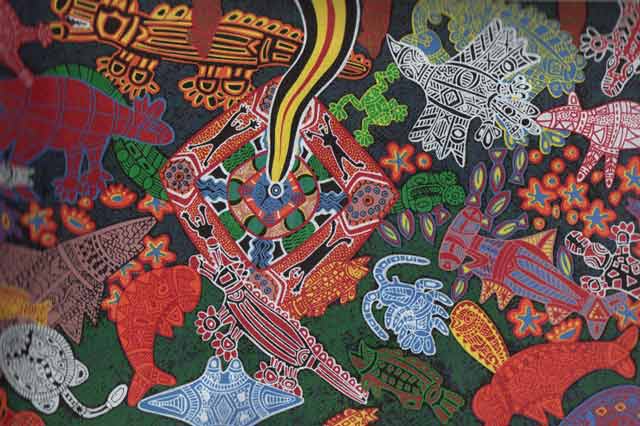
An Aboriginal creation myth portrayal.
 
1)   It is part of human nature to be curious. We need an explanation for everything, or else we are not satisfied. I think that this is the driving force beyond the formation of creation stories and myths of cultures worldwide. We attempt to explain our origins because in reality, some of us aren't quite sure what to believe. As human beings, we need reasons and logic to give us a sense of comfort and to help us define who we are both as individuals and as a society; we want to feel like a part of something bigger than any one person. These creation "myths" can still be found throughout the world to this day, although they may not be perceived as myths to some. The Bible offers an explanation of the origin of mankind, and Charles Darwin has proposed a theory that some people hold as fact and is even considered part of many schools' lesson plans for science classes. Some cultures pass down creation stories by generation, and even more common are fables that contain life lessons. Cultures find ways to leave a bit of themselves in all that they do, and just one way is through the telling of stories that seek to provide an answer to the question of the origin of mankind.


2 & 3)   From the creation stories of the Maori and Aboriginal cultures, we can begin to tell what each people values and believes in. Both the Maori and Aboriginal creation myths stress the existence of gods, and many at that. Each deals with a family of gods and the separation of their parents. There are many offspring in both stories, emphasizing the importance of repopulation within each culture. Family values are a common theme between the two cultures, with the Maori stressing that one should never turn on their family, especially their parents, and the Aboriginal calling for families to "live peacefully with one another." Man is created first in each story, coming back to the primitive idea of male supremacy over females. Individually, however, the stories do have their differences. The Maori consider the mother to be earth, displaying their strong appreciation for the creatures living on it, especially the humans, who are the only such organisms mentioned. The dark tone of the myth suggests their feelings towards death, and how the love of two people was seen as enough to prevent this. The Aboriginal creation story takes on a whole new tone, environmentally concious, and using the sun as a mother figure; hinting at the amount of value they see in life and their respect for animals. The story is nature-based and stresses growth, both physically and mentally. These differences may have resulted from the different locations and environmental factors of their countries, which could easily persuade each culture's specific view on the sun, the earth, and the animals. The lighter tone of the Aboriginal story may have been a result of a more positive interraction between the people and the animals, while the Maori may have condemned nature more because of harsh conditions at the time, but then again, I can only assume.


4)   Although they can be seen as outdated, the creation myths of both the Aboriginal and Maori cultures reveal challenges that still exist to this day. The Aboriginal story is very environmentally concious, and calls for the rest of the world to be the same. If modern times were as concerned with the environment as they had been, who knows if global warming would have ever been theorized? Would the condition of the ozone improve? Would we have a longer life expectancy rate and less polution, simply because we began to embrace nature the way the Australian Aboriginals had? Besides this problem, the Maori story addresses the amount of crime in the world. The story tells us of children struggling to separate and kill their parents in the quest for their own personal gains. Selfish reasoning drove them to attempt murder on their own parents, showcasing the greed that can be found across the globe, as well as weakening familial ties that cause children to become unstable without a strong sense of unity.

5)   I believe one hundred percent in the creation story as told by the Bible. In fact, it has always been my favorite Bible story. My faith has supplied me with answers as to where I come from and I have accepted them as truth. My beliefs have guided me throughout my life and make me strive to be a better person and to resist temptation. Because of my strong sense of where I come from, I value my religion that much more. I understand that no one is perfect and that God doesn't intend for us to be; He knows that we all make mistakes. This knowledge allows me to see the world with open eyes and to get to know people before I judge them, knowing that a person's imperfections only mean that they are human. Going to church, taking religious education classes, and listening to my parents' views growing up really helped to shape my views on creation. I believe that God created humans in His own image, but with individual imperfections that make us unique.

A Maori creation myth portrayal.


Blog 1 - Timelines.

          At first glance, it is impossible to know the background of a country. At further inspection, one may find that it has a lot more in common with a person's own country than previously suspected. Such is the case between Australia, New Zealand, and the United States.
          For starters, both Australia and the United States were colonized and settled by the British during the eighteenth century. The six colonies of Australia can be compared to the thirteen established in the US. The colonies of Australia later forming to establish a democracy in 1901 is also similar to that formed in under the American Declaration of Independence in 1776. A major difference between the two countries can be seen by the different amounts of time taken to achieve independence as well as a democracy within each nation. While the United States was able to break free from British rule within the same century as having been colonized, the six colonies of Australia took nearly 150 more years. Australia also continued to "pay allegiance" to Great Britain despite their creation of a Commonwealth (thefreedictionary.com). As far as the settlement of the three countries, another similarity can be found between New Zealand and the United States. English Captain James Cook visited New Zealand in 1769, his voyages inspriring other Europeans to travel to the intriguing country. Christopher Columbus sailed to the Americas in 1492, encouraging others to settle in this newfound land, and beginning the exploitation of natives that would be seen in many countries on many continents throughout history (en.wikipedia.org). Although the two men made their voyages at different points, they have both been credited as the explorers who brought about settlement in either country, despite not actually having discovered these lands themselves.
          The discovery of gold played a major economic role in all three countries, showing how greed transfers to be a worldwide trait. Gold rushes in New Zealand, Australia, and the USA occurred relatively around the same time, the mid-1800s. The NZ rush sprouted after the discovery of gold in Tuapeka, while the American gold rush began in California; both sent hundreds of thousands of people flocking to these areas in an attempt to get rich quick (en.wikipedia.org). The Australian gold rush was spearheaded by Edward Hargraves, who noticed the similarities between the geological features of Australia and California, and set out looking for gold once he realized that his observations proved to be correct (cultureandrecreation.gov.au).
          Outbreaks of war in both New Zealand and America showcase another similarity between the origins of the countries. The American Revolution consisted of a series of battles fought between the colonists and British for independence. A similar case, the native Maoris fought European settlers for nearly a decade in an attempt to gain back their homeland. On the contrary, Europeans did not up and leave New Zealand, as the British left American colonists alone for the most part after the revolution. However, in 1947 NZ gained independence from Britain, and the multiple cultures in both countries are able to live in peace today.

Australian Aborigines, who sought equality and fairness.

          Both Australia and the United States experienced segregation problems and an unequal distribution of rights. In 1962, Aborigines in Australia were granted the right to vote, and in 1967 they were considered citizens. Granted, these were the natives of the country, and they were just now gaining these rights that should have never been stripped of them in the first place. Going on during this same time period was the Civil Rights Movement in the United States. In 1963, Dr. Martin Luther King Jr. gave his famous "I Have a Dream" speech, one of the most influential and thought-provoking in history (pbs.org). He stressed his dreams of someday living in a country where all men were treated equally. These thoughts were shared not only by African-Americans in the US but also by Australian Aborigines, both calling for equal rights.
          In order to fully appreciate another culture, I feel that it is essential to educate oneself in the similarities between this new country and one's own, and also to learn the differences in order to obtain complete understanding of the place, the people, and their struggles.


Sunday, January 23, 2011

Blog 2 - Why We Travel.

1. I feel that my resons align with Pico Iyer's because him and I both travel to lose learn more about others but also to learn more about ourselves. We travel because of the experiences to be gained, learning about the culture of a place we have never been to and seeing sights we had never imagined we would get the opportunity to see in real life. Whenever I travel, I feel like I have escaped from reality into a whole new world; this is also when I feel most like myself. As Iyer says, "I can remake myself for better." I don't know what it is, but I just feel so much happier and even at home when, in actuality, I may be thousands of miles away.

2. "The real voyage of discovery consists not in seeing new places, but in seeing with new eyes."
Iyer means that you can't get the most out of your trip by simply going to a place, you have to go with an open mind that is ready to learn. You have to walk a mile in someone else's shoes and educate yourself with the way that the people there live life on a daily basis. Only then can you truly appreciate the sights that you see and the rituals that you observe while traveling. This relates to me because I really would like to come out of this trip, as well as all future travels, with a new view on the country I have just visited by learning about life there from the natives themselves.

3. "What gives value to travel is fear."
By this quote, Iyer is saying that the best trips are those in which not everything is planned perfectly. You don't know what is going to happen every minute of every day, and you don't always know what is going to happen at the places which you do visit. You have to take chances and try something new. I think that in order to even travel to another country in the first place, you have to step outside of your comfort zone and test your limits. Take risks, because you never know if you'll get the opportunity again. Even if it may scare you at first to do so, this good sense of fear is truly a sign that you are getting the most out of your trip.

4. Yes, I do think that travelers should share their experiences with others in order to educate them about other cultures. If the only way that people hear about different countries is through the media, personal experiences are lost in translation. People gain so much more from hearing stories from a primary source rather than on the news or in the paper. The best way to teach others about what is going on in the world is definitely by travelers sharing their first-hand experiences with them.

5. "And we travel, in essence, to become young fools again -- to slow time and get taken in, and fall in love once more." This is my favorite quote because it sums up why I travel. I feel most myself when I am traveling, because I don't have a care in the world. I am young and foolish and enjoying everything life has to offer. I get so wrapped up in the place that I am visiting that I feel as if I have escaped from the real world, from all troubles, and can just relax, take risks, and be myself. I am happy and loud and just thankful to be alive and to have had all of the opportunities that I have been given.